
J Radford Group Ltd, where yesterdays ethics combine with tomorrows technology to give you the total cleaning, restoration or renovation package.
Since John Radford's inception into the facade conservation industry over 25 years ago, he has built a reputation that is second to none in its field for integrity and quality of work at highly competitive prices.
From small beginnings trading as Radford Blasting Services the company has experienced (and is still experiencing!) year on year growth in all of the sectors it services. This planned expansion is due in no small part to employing only first class professionals who have a wealth of experience in their own fields.
These key people are more than capable of understanding and coping with every possible situation that might arise in works ranging in value from a few hundred pounds to major projects worth over a million pounds.
Our clients rest easy in the knowledge that all works undertaken by J Radford Group Ltd are carried out using staff that are employed by us, and not sub-contractors.
We are more than willing to offer references from a wide range of organisations to demonstrate our promise of providing a first class finished project, both on time and on budget, as you would expect from an ISO9001 and ISO 140001 registered firm, we are fully insured and can offer a comprehensive principal contractor, or specialist contractor service.
"We are conserving our heritage for future generations."
Why clean a building?
The subject of cleaning buildings, has at times in the past and even on occasion today, been a source of potential conflict...
Many people still see cleaning purely for aesthetic reasons and there are others, who realise that the enhanced appearance is not the most important benefit, derived from the process. There is also another group who after having seen the damaging results of the past (and on rare occasions of today), advocates completely leaving all pollution upon the surface, rather than risking further damage through removal, believing that this is the lesser of the two evils.
The use of 'safe' methods for the removal of damaging pollutants or coatings from a surface, should be seen as one of the most important factors without which, permanent changes can begin within the building surface as 'damaging irreversible chemical reactions' take place between both the pollutants and the surface.
Specialist Cleaning
"The importance of testing cleaning methods and materials cannot be over emphasized."
Employing the wrong cleaning method to historic masonry can have disastrous irreversible results. Acidic cleaners for example can be extremely damaging to acid-sensitive stones, such as marble and limestone, resulting in etching and dissolution of these stones. Other building materials also may be affected by the cleaning process. Some chemicals, for example, may have a corrosive effect on paint or glass.
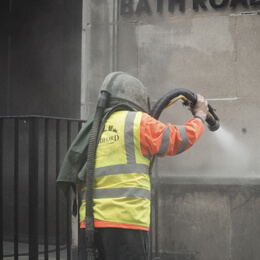
Here at J Radford Group Ltd we specialise in the Innovative Jos/Torc and Doff Systems which in many conservator's minds is the safest way to clean a facade.
We are very proud to be accredited with Stonehealth Ltd as an approved Contractor.
Restoration
"Following the cleaning, the scope of the repairs is fully realised."
Each project is assessed individually and the appropriate repair carried out taking into consideration the extent of the decay, the materials, the durability and the budget confinements.
Wherever possible the original facade will be maintained and only where necessary will repairs be carried out.
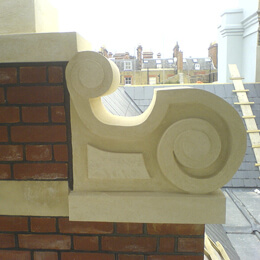
Our craftsmen have a wide experience covering all types of restoration whether by replacement with matching suitable materials such as stucco, render, stone, brick and concrete or by making good use of specialist repair mortars. All times J Radford Group Limited will advise on the most appropriate method of repair.
J Radford Group also has considerable experience in the restoration and replacement of terracotta and faience facades.
Our employees have worked with most conservation architects and English heritage restoring historic landmarks such as Arnold Circus, The Globe Rehearsal Studio's, Victoria and Albert Museum and the Tower of London to name a few.
Introduction
Grit blasting is a process where abrasive particles are pneumatically accelerated and forcefully directed against a surface. These high speed abrasive particles remove contaminants from the materials surface and condition the surface for subsequent finishing.
All J Radford Group blasting personnel are trained to our own exacting standards that exceed the normal guidelines and all our operatives have undergone specific training with Hodge Clemco.
We have nearly thirty years experience in the field and can offer advice on any project no matter how large or small. As you would expect from an ISO9001 and ISO 140001 registered firm, we are fully insured and can offer a comprehensive principal contractor, or specialist contractor service.
Introduction
Grit blasting is a process where abrasive particles are pneumatically accelerated and forcefully directed against a surface. These high speed abrasive particles remove contaminants from the materials surface and condition the surface for subsequent finishing.
All J Radford Group blasting personnel are trained to our own exacting standards that exceed the normal guidelines and all our operatives have undergone specific training with Hodge Clemco.
We have nearly thirty years experience in the field and can offer advice on any project no matter how large or small. As you would expect from an ISO9001 and ISO 140001 registered firm, we are fully insured and can offer a comprehensive principal contractor, or specialist contractor service.
Surface preparation
For almost 30 years John Radford has specialised in surface preparation and cleaning services, which include blast cleaning, sand blasting, pressure washing, chemical cleaning and steam cleaning services.
We also offer post blast cleaning services such as priming and painting including stone and brick sealing using the latest products.
If you are looking for a local contractor specialising in surface preparation including blast and sand blasting services, pressure washing, chemical stripping and steam cleaning we can help. We cover a wide geographic area including the whole of London, Hertfordshire, Essex, Kent and have been known to take on projects in Manchester, Liverpool and as far away as Scotland. As members of the J Radford Group Ltd nationwide coverage can be arranged. For a free no obligation quote call our offices or send us an email via our contact us page.
Facade Cleaning
There are various methods of brick cleaning, stone cleaning or removing paint and old coatings from substrates. We at the J Radford Group can employ many different methods, to determine the most suitable we always carry out a test clean to ensure best cleaning results and no damage. Building cleaning carried out by experienced blast operatives using the correct abrasive, techniques and pressures can be very effective. We have restored many old buildings, with outstanding results and no two jobs are the same, each new surface to be cleaned needs to be tested to find the right solutions so that achieving the desired result does not damage the surface. The use of water, wet blasting with the abrasive offers an environmentally friendly alternative but with the same impressive results. Cleaning a facade can substantially increase the value of your investment
Torc system cleaning is an alternative to sandblasting when cleaning brick or cleaning stone A specially formulated medium is directed onto the surface at minimum pressures in a swirling vortex. The Torc system in the right hands will not cause damage to any substrate.
Steam Cleaning Bays
The removal of road dirt and grease prior to repair work is essential to produce a high quality end result. All vehicles go straight into our eco-friendly steam cleaning area to be thoroughly washed. As we are ISO14001, the awareness of ever improving environmental issues are very important to us.
Steam Cleaning Bays
The removal of road dirt and grease prior to repair work is essential to produce a high quality end result. All vehicles go straight into our eco-friendly steam cleaning area to be thoroughly washed. As we are ISO14001, the awareness of ever improving environmental issues are very important to us.
Shot Blast Booth
The state of the art 20 metre long shot blast booths come with the latest recycling and dust extraction equipment to ensure environmental impact of blasting is at an absolute minimum. Many types of blasting medium can be used; for environmental protection we use aluminium oxide, this gives a top quality finish and can be recycled and reused many times. As our roots come from the grit-blasting field, we pride ourselves on our extreme knowledge in every grit blasting area.
Crash Repairs
We undertake a wide range of repairs on all vehicles, from minor scrapes to major crash repairs. As we are recognised repairers for all main Insurance Companies you can always rest assured your repairs would be completed to the highest standards.
Preparation is crucial in ensuring a high quality finish and our technicians take great pride in their prep work to ensure they are happy with the end result, which means the customer will be too!
Spray Booths
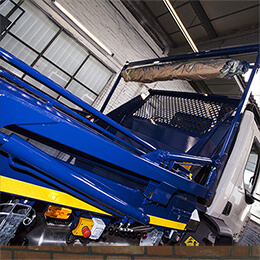
Our modern facility houses two commercial vehicle and plant equipment spray booths, giving us the capacity to spray the longest trailers and tractor units at the same time. Furthermore, we can accommodate the longest length special type heavy haulage trailers by linking up both booths - giving us an overall booth length of some 26m
Our facilities are capable of handling the largest of road-going vehicles; from vans to concrete pumps, and more!
The Body & Paint Team
One of our biggest assets is our dedicated Team. Between them, there are over 250 years experience in body repairs and paintwork.
Ongoing training is of paramount importance; many of our staff will already be City & Guilds or NVQ qualified and we are continuously undergoing in-house training, working with all the major paint manufacturers as partners to ensure we are all meeting the same very high standards.
Our dedicated Team are either fully skilled, apprentice trained or serving apprenticeships giving us a good mix of people with different experiences and ideas.
On Site Spray Painting
At the J Radford Group we have 6 fully fitted mobile teams for on site spraying of commercial shop fronts, interior fittings and industrial machinery etc across the UK
We operate a fleet of mobile paint spraying teams who can travel across the UK painting buildings, interior fixtures or exterior fittings that other painting systems just don't deliver on. Professional spraying is fast, clean, and quick to dry and leaves a perfect smooth finish ideal for seamless branding and coating of a huge range of building materials. Carrying out full surveys with expert advice and design support our mobile teams are fully equipped to offer a complete paint spraying workshop capability on site.
With the assurance of being an iso 9001 and iso 140001 accredited company your project will get the attention and quality of workmanship it deserves.
Protective Coatings
We provide a professional protective coating service for your silo, vessel, building or any other structure both internal and external.
We only use coatings of known quality and durability and in many cases we are able to offer an insurance backed guarantee.
To prevent corrosion from the weather or other local condition (acid rain areas, adjacent to corn dryers etc) or the ingress of water or purely for cosmetic reasons.
Our Mobile Coating Service can provide you the solution to restore a failing or unsightly silo or structure back to a safe and cosmetically pleasing standard whilst providing protection for the years to come.
We provide many methods of restoration from simple cleaning back by abrasion and painting through to very high level access shot blasting for the removal of rust, failing coatings, mill scale etc through to complete panel or component replacement of the structure, internal or external.
We also offer repairs to:
Ani-Graffiti Coatings
Anti-Graffiti Barriers
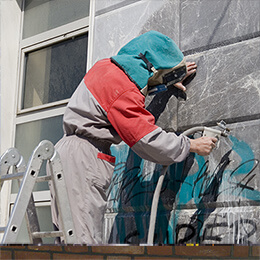
As it is not usually possible to prevent graffiti, removal methods must be both efficient and fast. The best method of easing graffiti removal is generally agreed to be the insertion of a barrier between the surface and the defacing material, such as paint spray, crayon or marker pen.
Sacrificial Anti-Graffiti Coatings
Anti-graffiti barriers and coatings fall into three distinct categories. Sacrificial coatings are mostly based on easily removable waxes. After soiling with graffiti, both the wax and graffiti are removed together, sometimes with solvents or more commonly by melting the wax with steam or hot water. The biggest problem with this approach is that the coatings must be replaced after each removal operation, which is time consuming and expensive.
Semi-Permanent Anti-Graffiti Coatings
Semi-permanent coatings are commonly based on acrylics or cross-linking systems, such as epoxy, urethane or polyester. They can be multi-coat systems that possess a moderate degree of resistance to aggressive cleaning chemicals. These coatings will normally withstand a few graffiti-removal operations with strong chemicals, but eventually attack by the removal chemicals makes replacement necessary. Aggressive removers are necessary as the marking media usually has some affinity for the coating and a degree of adhesion or diffusion of the marking media takes place, which tends to increase with time.
Permanent Anti-Graffiti Coatings
Permanent coatings are relatively new and offer an extremely long-life surface from which graffiti, fly-posters and other soiling can be removed repeatedly, using safe and mild agents, without the loss of properties, performance or appearance of the coating itself. Coatings of this type normally have release properties similar to those of non-stick domestic kitchenware. Any soiling can easily be removed using aqueous surfactant/detergent mixtures, or at worst, benign chemical mixtures which have little or no effect on the coating itself, resulting in a truly permanent anti-graffiti coating.
Non-Stick Surfaces
Fluorine-Based Non-Stick Systems
The two elements fluorine and silicon are pre-eminent in the world of non-stick applications. Most people are familiar with non-stick frying pans and baking utensils, which have a polymeric coating resin containing fluorine atoms. One of the most familiar examples of these coatings is Teflon, a PTFE polymer which owes its non-stick characteristics to the high fluorine content of the structure. Unfortunately, fluorine-containing polymeric resins are expensive and extremely difficult to apply, but the degree of non-stick achieved can be extremely high.
Silicon-Based Non-Stick Systems
Silicon atoms, joined to oxygen atoms in long molecular chains, produce silicone molecules with variants called silanes and siloxanes. Resins made from long chains with alternating silicon and oxygen atoms, when dried or suitably cross-linked, can result in non-stick coating systems. The degree of non-stick is nearly as high as that achieved with fluorine-containing coatings, but the price is normally much lower and the case of application on most surfaces is usually improved.
Other Chemically-Active Groups Used in Non-Stick Systems
Some semi-permanent anti-graffiti coatings, even when fully-cured, still have chemically-active groups such as hydroxyls and keto-groups at their surfaces. Sometimes, these groups can act as bonding-sites for graffiti resins, making them quite difficult to remove. So cleaning requires the use of chemicals capable of breaking these bonds. Additionally, mild abrasion is sometimes required in order to supplement the chemical action. This has a deleterious effect upon the coating itself, even after relatively few cleaning cycles.
Disadvantages of Non-Stick Systems
To get around these problems of degradation, largely chemically-inert coatings such as fluorinated resin systems and silicones/siloxanes are popular. These are inherently non-stick, having few or no bonding-sites to which graffiti inks can adhere. Unfortunately, most fluorinated-resin systems also have other problems, such as the need to use unwholesome curing agents or activators (such as isocyanates), and the use of smelly, toxic and flammable solvents for the resin or curing agent.
Epoxy-Modified Siloxane Anti-Graffiti System
One epoxy-modified, siloxane clear coating system recently developed for Urban Hygiene, an anti-graffiti coatings manufacturer, has been undergoing a series of laboratory and in-use tests. The coating has proved that it can overcome some of the existing problems with these types of coatings, many of which are not able to provide a clear finish.
The Systems and Its Properties
The engineered siloxane has a two pack, high-solids system that is virtually solvent-free, has few bonding sites for defacement inks, and has very high resistance to abrasion when fully-cured, so it is extremely resistant to the less aggressive chemicals used to remove graffiti. The single-coat system has a low cost per unit area, and most importantly, can be purged of graffiti with the mildest of environmentally-safe chemicals, retaining its non-stick surface-energy after dozens of cleaning cycles.
"Project: Private dwelling in SE9"
"Value: £2,900 Client: Mr Vijay Patel"
J Radford Group Ltd takes pride in all our contracts no matter what their size. Take Mr Patel's property it was in need of a face lift.
Look at the property next door the fracture in Mr. Patel's brickwork was more severe and we had to embed heli bar reinforcement rods to stop it from moving any further.
Once the building emerged from the Monoflex sheeting that had kept it cocooned for 2 weeks the end results were plain to see a fully cleaned restored facade that actually led to 6 more properties in the area being cleaned and re-pointed.
"Project: Arnold Circus, Bethnal Green, E2"
"Value: £ 500k + Client: Friends of Arnold Circus and English Heritage."
J Radford Group Ltd is proud to be appointed sub-contractors on this site of particular interest owing to its unique history, current listed status and special place in the hearts of the residents.
Arnold Circus has undergone a sensitive restoration program. Briefly the works that were carried out consisted of:
As a company we have a history of heritage projects stretching back over 25 years. Currently we are approved contractors for many well known contractors such as The Apollo Group, Durkan's, Gunite, and Balfour Beatty amongst others and are engaged in three Royal Parks amongst other works. We commenced site set up on Monday the 8Th March and grit blasted the outer railings and primed them ready to receive their new top coat. The inner railings were dismantled and transported to our yard in Bedmond where they were grit blasted. Due to years of weather erosion we then carried out extensive repairs to each panel replacing up to 50% with like for like material. The project was completed successfully with both the client and English Heritage complementing us on the end results.
"Project: Old Pye Street, Victoria."
"Value: £1.6 million Client: Gunite & Waites"
Once again J Radford Group was proud to work along side contractors such as Waites on another historic housing estate this time in the heart of Victoria.
9 blocks of flats equating to over 240 dwellings underwent an extensive cleaning and restoration program as well as receiving new double glazed sash units and redecoration of the communal areas.
The housing estate was built for the underprivileged way back in 1888 and later came under the management of the Peabody Trust. Utilising the latest technology (Doff system) over 120 years worth of dirt, grime and harmful pollutants were cleaned away with ease and the building was restored to its original glory.
"Project: Fenwick's, New Bond Street"
"Value: £ 26.5k Client: Stonewest Ltd"
J Radford Group was involved in the surface preparation utilising the unique Jos/Torc system from Stonehealth Ltd on one of the privately-owned group of department and fashion stores founded by J.J. Fenwick in Newcastle upon Tyne in 1882.
This particular project involved the careful removal of 5 layers of paint yet leaving a uniform finish with no abrasion to the substrate ready to receive its new coatings. Fenwick's advertising on the scaffold sheeting read "We are just powdering our nose" English Heritage were very happy with the end results as were the clients.
"Project: Freemason's T Block, Vauxhall."
"Value: £180k Client: Galliard Homes Ltd"
Once again J Radford Group Ltd was involved with the refurbishment of an old run down Victorian building.
In this instance we had to remove over 100 years of paint to 18,000M2 of internal brickwork.
Originally they were going to plaster the walls after they had been prepped with the grit blasting system, the architect was so impressed with the end result they decided to retain the brick facade as a main feature in the internal design.
With the clever placement of lighting the end results were astounding.
"Project: Camberwell Public Baths."
"Value £32k Client: Buxton Building Contractors"
J Radford Group was asked to remove 11 layers of paint from the timber roof beams of this old run down swimming baths.
Originally built in 1981, the building provided public baths and wash houses for members of Camberwell's community.
Once the timber was prepared utilizing our soft air abrasive system it was then primed and coated with chlorinated rubber paint, the finished results are stunning.
Bartletts Gallery
Heritage Gallery
J Radford Group Ltd
J Radford Group Ltd, where yesterdays ethics combine with tomorrows technology to give you the total cleaning, restoration or renovation package.
Unit 4-7 Pudds Industrial Estate
Ley Hill Road Bovingdon, Herts
HP3 0NW
0800 5870754 info@jradfordgroup.com